Complete model answers to every question of the CBSE Class 10 English Language and Literature (184) Sample Question Paper 2026-27, covering reading, grammar, writing and literature, with the either-or options, matching the value points of the official marking scheme.
Feel The Real Exam Before The Real Exam
Want to practise full papers like this under exam conditions? Share your name and number and we will WhatsApp you the Class 10 Test Series details.
Quick Facts
| Paper | CBSE Class X English Language and Literature (184) Sample Question Paper 2026-27, with marking scheme |
|---|---|
| Marks and time | 80 marks, 3 hours, 11 questions, all compulsory |
| Sections | A Reading (20), B Grammar and Writing (20), C Literature Textbook (40) |
| Pattern change | None for 2026-27, as printed by CBSE |
| Source | Official CBSE sample paper and marking scheme, cbseacademic.nic.in |
| Enquire about the test series | WhatsApp 7709585248 or support@edufestacademy.in |
How To Use These Solutions
This is the complete CBSE Class 10 English Language and Literature (184) Sample Question Paper 2026-27, answered by a teacher in the order of the paper. The answers follow the official marking scheme.
English answers are value points, not fixed wording. The marking scheme itself says students can use their own expression if it is correct. Use our answers to check the ideas you should have covered, and then write in your own words.
Read the two passages and the extracts in the official PDF (linked at the end) before reading the answers. Try each question yourself first.
Section A: Reading (Q1 and Q2, 20 marks)
Two passages of 10 marks each. Answer from the passage, in your own words where the question says 'explain' or 'what might'.
-
Q1 (10 marks).
Passage on plastic toys and eco-friendly toys (six paragraphs, 435 words).
I (1): 'Rows upon rows of plastic products' emphasises the overwhelming abundance and endless rows of plastic toys in stores. It shows how common plastic products have become in consumer culture.
II (1): (a) the potential health hazards present in mass-produced plastic toys that consumers often ignore or are unaware of. (The writer says these are 'real concerns that affect real people', so they are not abstract.)
III (1): C. Plastic bottles processed and converted into shoes. Recycled material is waste turned into something new.
IV (2): The comparison shows that consumer responsibility goes beyond convenience and affordability. By setting harmful chemicals (BPA and lead) in plastic toys against the safer, more sustainable materials in eco-friendly toys, the writer suggests that consumers should put children's health and the environment before cost. Informed choice is both a personal and a collective responsibility.
V (1): False. The passage says natural materials engage the brain 'in deeper ways', so they help thinking and problem-solving, not only entertainment.
VI (1): (b) meaningful keepsakes : future generations. As disposable trinkets end up in landfills, meaningful keepsakes are passed to future generations.
VII (1): D. (i) F, (ii) O, (iii) F, (iv) O, (v) O. A fact can be checked (BPA and lead are used; eco toys are designed to last). An opinion is a judgement ('attractive', 'deeper and more meaningful', 'mindful consumption').
VIII (2): The author asks rhetorical questions to engage readers directly and make them think about their choices. They build a persuasive argument that leads readers towards accepting eco-friendly alternatives.
-
Q2 (10 marks).
Case-based passage on the rise of audiobooks (four paragraphs, 253 words).
I (1): become a support in people's lives. 'Mainstay' means the chief support.
II (1): It suggests that consumers increasingly prefer digital, on-the-go content that fits mobile lifestyles, rather than physical books or stationary screen-based media.
III (1): C. The assertion is true, but the reason is false. Commute is the most popular scenario (63%), but the passage does not say that listeners struggle with short attention spans while travelling.
IV (1): C. Approximately 30% of listeners spend less than one hour weekly. The passage says 50% spend 1 to 4 hours and 33% spend 5 to 10 hours, so the rest (not 30%) listen for less time, and the paragraph does not give that figure.
V (2): The strong preference for fiction (56%) shows that audiobooks are used mostly for narrative-driven content. Storytelling works better in audio, because the narrator's voice and the twists of the plot add to the engagement.
VI (1): ...because audiobooks allow people to take in literature while doing other things, so they need not set aside dedicated time for conventional reading.
VII (1): 'user-friendly format'.
VIII (1, any one): The audio format removes the text-processing barrier, such as decoding words and reading sentences, for students who struggle with reading. Or: they can still engage with the book despite their reading challenge.
IX (1, any one): The title covers all the main ideas of the passage and acknowledges the shift shown by the 67% of listeners who read more with audiobooks. Or: it balances the key ideas of the four paragraphs, the growing popularity and the benefits.
Section B: Grammar (Q3, 10 marks)
Any ten of twelve tasks, one mark each. Each answer comes with the rule behind it.
-
Q3 (10 marks).
Complete any ten of the twelve grammar tasks.
I. B. was reviewed. The action happened 'last week' (a fixed past time), and the application is the receiver of the action, so the passive in the simple past is right.
II. The doctor advised the patient to reduce his (her) sugar intake and exercise regularly. 'Should' in advice becomes 'advised ... to' in reported speech.
III. B. those. 'Those applicants who ...' points to people being described.
IV. ...she had been absent the previous day because she had had to visit the dentist for her regular check-up. In reported speech, 'was' becomes 'had been', 'had to' becomes 'had had to', and 'yesterday' becomes 'the previous day'.
V. Error: were. Correction: was. With neither ... nor, the verb agrees with the nearer subject, 'the project manager', which is singular.
VI. C. must. A safety rule expresses obligation.
VII. Error: What. Correction: Which. 'Which' is used when the choice is from a limited, known set (these books).
VIII. ...if she was prepared for the mathematics test the following week. A yes-no question is reported with 'if' or 'whether', and 'next week' becomes 'the following week'.
IX. D. little. 'Food' is uncountable, and 'little' (almost none) fits the disappointment.
X. Error: have. Correction: has. 'Each' takes a singular verb.
XI. might. It shows a possibility, not a certainty.
XII. has lost. 'Since the last time I saw it' needs the present perfect.
Tip: only ten are needed. Attempt the ten you are surest of. Marking is one mark each.
Section B: Writing (Q4 and Q5, 10 marks)
A formal letter and an analytical paragraph, 5 marks each, with an either-or choice in both.
-
Q4 (5 marks).
Either A or B. Format 1, content 2, organisation 1, accuracy 1. A. As Maya Nair of Green View Colony, Guwahati, write a letter (120 words) to the Secretary of the RWA about the need for a community centre. OR B. As Nandan Banerjee, write a letter to the Editor about the open burning of hospital and domestic waste.
Format for both: sender's address and date at the top right, the receiver's designation and address, the subject line, the salutation (Sir/Madam), the body in short paragraphs, the complimentary close (Yours sincerely) and the name.
Model for Option A (about 120 words in the body):
Subject: Request for a community centre in Green View Colony
Dear Sir, I am a resident of Green View Colony and write to draw your attention to the lack of recreational and community space in our colony. The existing facilities are insufficient for residents of all ages. A community centre would give children a safe place for indoor games and workshops away from traffic, and give adults a venue for meetings and cultural programmes. Yoga and fitness classes would help the elderly, and social events would reduce their isolation. It would also bring families together and build a sense of belonging. I request you to place this proposal before the RWA committee and begin work soon. I assure you of the full cooperation of the residents. Yours sincerely, Maya Nair
Content points the marking scheme accepts for Option B: the open burning of used syringes, bandages and household garbage in public places; toxic gases and soil and groundwater contamination; asthma, bronchitis and lung damage, and infections from unprocessed biomedical waste, especially for children, the elderly and pregnant women; strict biomedical waste rules for hospitals, colour-coded segregation of waste and regular municipal collection; awareness campaigns with the RWAs; and an appeal to the newspaper and to the Municipal Corporation and the Pollution Control Board to act.
Model opening for Option B: 'Through the columns of your esteemed daily I wish to raise a serious concern about the open burning of hospital and domestic waste in our city...' Then cover health effects, scientific disposal and awareness in one paragraph each, and close with an appeal.
-
Q5 (5 marks).
Either A or B. Analytical paragraph (content 2, organisation 2, accuracy 1). No title. A. Why would the bamboo study desk organiser be a good purchase for students? (about 120 words) OR B. Should Vikram accept the presidency of the Debate Club? (100-120 words, using the SWOT notes)
Reminder from the marking scheme: an analytical paragraph is not a description or a summary. It examines the given elements and gives a judgement.
Option A (marking scheme's model response):
The student study desk organiser is an excellent purchase for students who are academically focused and like to keep things organised. Firstly, its multi-compartment storage with dedicated slots for books, stationery, and devices keeps the study space organised and clutter-free, helping one focus better on studies. Secondly, the eco-friendly bamboo wood construction shows environmental responsibility, making it a sustainable choice. Moreover, adjustable shelves allow storage space customisation for different-sized items. The compact design is perfect for small rooms. Additionally, the anti-slip base prevents the organiser from sliding on smooth surfaces, ensuring safety and stability. Furthermore, the natural wood and light oak finishes look attractive and suit any room décor. Finally, the five-year durability guarantee guarantees quality and excellent value for money, making this organiser an excellent choice and a smart investment for students.
Option B (marking scheme's model response):
Accepting the Debate Club presidency offers Vikram significant opportunities to develop leadership and public speaking skills while building a strong network of peers. The recognition gained at competitions and mentorship from experienced debaters could strengthen his university applications in future. However, these benefits are offset by some challenges. The 5-7-hour weekly commitment directly conflicts with board examination preparation, risking academic decline and burnout. Additionally, managing team conflicts and handling criticism demands substantial emotional effort. While collaborating with other clubs presents growth opportunities, it results in limited time available for personal interests and recreational activities. Consequently, Vikram should accept this position only if he can establish robust time management strategies and prioritise academic commitments. With proper planning, the benefits of leadership development and personal growth likely outweigh the challenges.
How to build it: open with your judgement, then weigh the strengths and opportunities against the weaknesses and threats using linking words (however, moreover, consequently), and end with a clear recommendation.
Section C: Literature, the Extracts (Q6 and Q7, 10 marks)
Each extract has four parts. The extracts are from a play, a prose lesson and two poems.
-
Q6 (5 marks).
Either A or B. A. Extract from The Proposal (Natalya and Lomov). OR B. Extract from Bholi (Bholi says her full name in class).
Option A:
I (1): (a). Natalya's words show genuine surprise and curiosity, not mockery. Her sincere compliment 'you look better' and her plain questions show that she only wants to know why he is dressed formally.
II (1): C. The ellipses show his anxiety and emotional turmoil.
III (1, any one): He is nervous about proposing and wants to establish his worthiness and family connections to win her approval. Or: he hopes to impress her by showing respect and good intentions through formal address.
IV (2): [excited] shows Lomov's inner agitation behind his formal speech, which creates dramatic irony. [aside] lets the audience hear his private thoughts, so his anxiety becomes visible and relatable, and his remark that it is cold stresses his nervousness.
Option B:
I (1): extremely scared and anxious (nervous and apprehensive).
II (1): C. giving readers a peek into Bholi's thoughts. The question is an internal monologue, which shows her fears directly.
III (2): Despite her stammer Bholi says her full name after the teacher's encouragement. This shows that her fear of being judged, which is psychological, is the main obstacle. By addressing her emotional state with compassion and reassurance, the teacher helps her overcome the stammer.
IV (1): hope and hesitation.
-
Q7 (5 marks).
Either A or B. A. Extract from the poem Amanda. OR B. Extract from the poem The Trees.
Option A:
I (1): Amanda's physical appearance and health (or the immediate consequences of her choices).
II (1): B. Amanda is defiant, and the speaker feels disrespected and ignored.
III (1): request. 'Will you please' sounds like a request rather than a demand.
IV (2): The repetition of 'Amanda' stresses the speaker's frustration and gives a nagging quality. The exclamation marks show urgency, exasperation and emotional intensity. Together they set a tone of frustrated concern and a mood of tension and conflict.
Option B:
I (1): a sense of immediacy (or urgency).
II (1): C. unsteady and uncertain (while breaking through all obstacles).
III (1): fundamental (or inevitable).
IV (2): The sensory sequence mirrors the process of change: chaos begins with the sound of breaking glass, grows through the struggle in the trees stumbling forward, and ends in the beauty of the flashing moonlight. Using several senses draws readers into the experience emotionally, rather than just informing them.
Section C: Literature, the Short Answers (Q8 and Q9, 18 marks)
Write 40 to 50 words, with a clear point, a reason and a link to the text.
-
Q8 (12 marks).
Answer any four of five questions in 40-50 words (3 marks each: content 2, expression 1).
I. Fog (the cat metaphor): The fog arrives silently like a cat's quiet footfall, settles, observes and then departs without disturbing anything. This gives the fog feline qualities, mysterious, aloof and watchful, and turns a natural event into something unknowable. It also links living and non-living nature in the reader's imagination.
II. Mijbil the Otter (humour): The comic descriptions entertain, such as Mijbil's playful mischief with the tap. They also criticise people. The absurd guesses of Londoners, and the labourer's indignant reaction, show people's habit of fitting an animal into a fixed category like 'rat', which shows human arrogance and distance from nature.
III. A Letter to God (the hailstorm): The hailstorm is a turning point that tests Lencho's faith. It destroys his crop and starts his crisis, but it also shows his unwavering belief and the postmaster's compassion. The disaster reveals character and creates a chance for human kindness.
IV. The Tale of Custard the Dragon (appearances): Today people often judge others by appearance, social media image or first impressions. Custard's story shows that true character appears in action under pressure, not in looks or noise. It challenges the modern tendency to judge worth quickly on limited information.
V. Tea from Assam (the legends): The legends of the Chinese emperor and Bodhidharma bring tea's history to life beyond dates and facts. They show how Chinese and Indian cultures valued tea spiritually and medically, and show that tea has cultural meaning and not only commercial value. They also make the narrative more interesting and memorable.
-
Q9 (6 marks).
Answer any two of three questions in 40-50 words (3 marks each).
I. The Thief's Story: Hari first manipulates Anil with calculated charm and deceit. His smile at the end is honest and spontaneous. The contrast shows a real change: Hari moves from seeing people as chances to exploit to valuing genuine human connection. The effortless smile suggests that the change is inside him, and not just good behaviour.
II. The Necklace (irony): Matilda gives up everything to replace a necklace that was worthless. Ten years of poverty turn her into the 'common woman' she despised, and her pride becomes her downfall. The final irony is that her suffering was needless. Through irony the writer criticises materialism and shows how vanity leads to self-inflicted tragedy.
III. A Question of Trust (the gloves): Horace takes off his gloves to give the lady his lighter because he drops his careful habits of a criminal. He is eager to please her and be free, and forgets basic precautions. This shows his desperation and his vulnerability to her manipulation, and that he is thinking like a desperate man seeking escape.
Section C: Literature, the Long Answers (Q10 and Q11, 12 marks)
Write 100 to 120 words in three short paragraphs: the central idea, the evidence from the text, and a closing judgement.
-
Q10 (6 marks).
Either A or B, in 100-120 words (content 3, expression 2, accuracy 1). A. Compare how the catalysts drive the change in Valli (Madam Rides the Bus) and the young seagull (His First Flight). OR B. How do The Ball Poem and Dust of Snow show that momentary events generate a lasting impact?
Option A (value points from the marking scheme):
Both Valli and the young seagull go through a major personal change, but through different catalysts. The seagull's change is driven by biological necessity. Long hunger and being left alone force an instinctive action that overrides fear, and the desperate dive reveals the flying ability within him. This catalyst is external and involuntary.
Valli's catalyst is internal. Curiosity and a yearning for experience, seen in her fascination with the bus, push her. She longs for the independence and dignity that the bus represents beyond her domestic limits.
Yet both catalysts work in the same way. They force the protagonist to free suppressed potential, and show that change needs a catalyst strong enough to overcome fear, whether it is hunger or the wish for independence.
Option B (value points):
Both poems show that important learning can happen in an instant. When the ball falls into the water, the boy understands the permanence of loss at once. When the dust of snow falls on the speaker, the mood changes immediately.
Berryman suggests the boy will remember the lesson forever: one lost ball teaches loss and responsibility for life. In Frost's poem the effect also lasts, as the speaker's whole day changes. The moment is short, but its effect is long.
The boy does not reason about loss step by step, and the speaker does not reason about beauty. Both feel it directly in one moment.
-
Q11 (6 marks).
Either A or B, in 100-120 words. A. In The Midnight Visitor the balcony never physically exists. What does it symbolise? OR B. In The Book that Saved the Earth, Think-Tank rules with absolute authority and arrogance yet makes ridiculous mistakes. Evaluate how this impacts his leadership.
Option A (value points):
The balcony symbolises the power of narrative to create reality. It exists only in language, in Ausable's detailed description and in Max's belief, yet it becomes more real than the room, because the characters act on it. Ausable builds it through plausible details: the history of the building, the routes of access and earlier intrusions.
The imaginary balcony shows how truth and perception differ. Max accepts it because Ausable's account matches what he expects of a Paris hotel.
In the end the balcony stands for the triumph of storytelling over material fact. Ausable knows that controlling the story gives complete power, so a fictional balcony has more effect than any physical barrier.
Option B (value points):
Think-Tank shows the danger of absolute power joined with absolute ignorance. He refuses to admit errors, and so turns foolishness into catastrophe. He mistakes books for sandwiches, then hats, then weapons, and each time claims it proves his genius. When corrected he says he knew it. His intelligence is useless without humility.
His authority makes the flaw dangerous. As no one challenges him, he gets no honest feedback, and his crew's fearful obedience prevents any reality check. His errors grow: nursery rhymes become military threats.
At the climax he panics at the image of Humpty Dumpty and orders Mars to be evacuated. Unchecked power with arrogance and foolishness makes destructive leadership, and his huge brain becomes a liability.
Five Answer-Writing Habits That Earn Marks In English
- 1. Answer from the passage. In reading questions, base every answer on the text, and use your own words for 'explain' and 'what might'.
- 2. Learn the grammar rule, not the example. Reported speech, agreement and modals repeat in new sentences. Know the rule so you can apply it.
- 3. Give a reason in literature answers. Make a point, give the reason, and link it to the text. A bare statement earns the first mark only.
- 4. Keep to the word limit. 40 to 50 words for short answers and 100 to 120 for long answers. Practise until you can judge the length by eye.
- 5. Check accuracy at the end. Spelling, punctuation and tenses are marked in every written answer. Leave two minutes to check.
More On The 2026-27 English Language and Literature Paper
Where This Paper Comes From
Everything here is based on the Sample Question Paper and Marking Scheme for Class X (2026-27), English Language and Literature (184), published by the Central Board of Secondary Education on cbseacademic.nic.in. Marks and the paper design are as printed by CBSE.
The tagging of each question to a chapter or skill is our own reading as teachers. Some questions use ideas from more than one chapter, so another teacher may tag one or two questions differently.
Ready To Try A Full Paper Under Exam Conditions?
Reading a solution is not the same as writing the paper in the exam hall. Use chapter-wise tests to find your weak chapter, then full mock tests in the real board pattern.
Two Class 10 Test Series At EduFest, Bavdhan, Pune
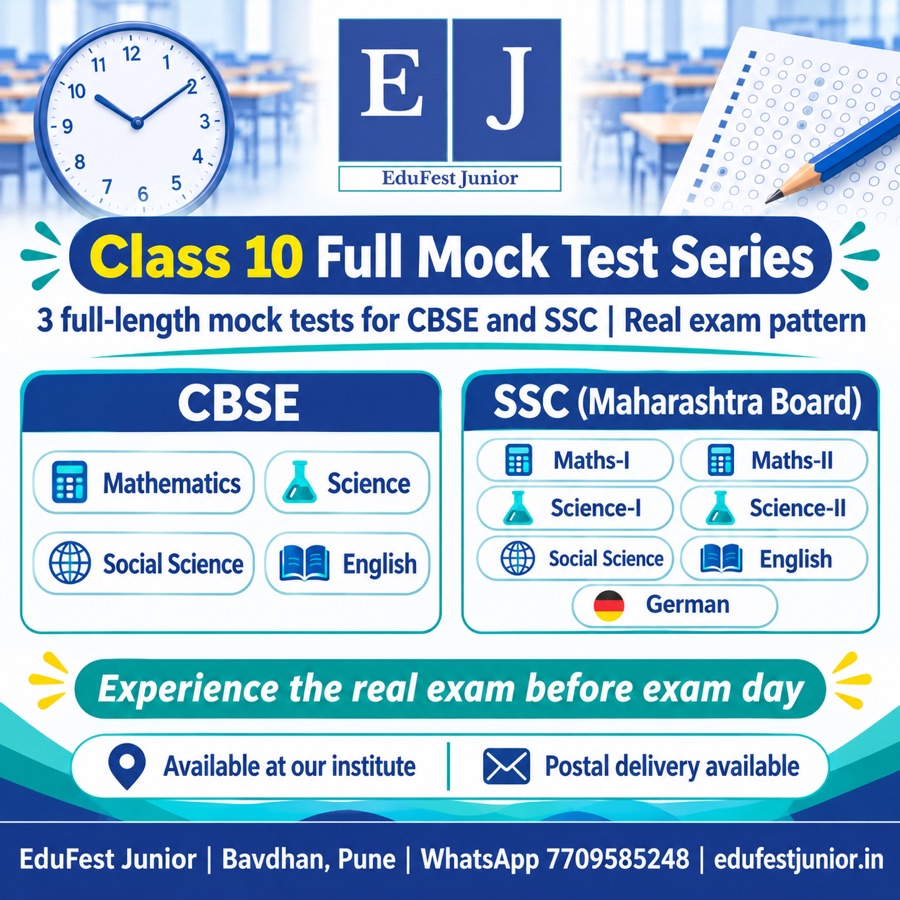
EduFest Junior Academy runs two separate series for Board Exam 2027, both starting 1 Dec 2026, for CBSE and Maharashtra State Board (SSC) students.
The Topic-Wise Test Series gives 10 chapter-wise Mathematics tests per board (Science is coming soon), with concept clarity first, real board-pattern papers, a separate answer key and chapter-wise weak-area diagnosis. Price is available on WhatsApp.
The Full Mock Test Series gives 3 full mock tests per board in real board paper pattern with an answer key, for Rs 4,000 per board. Take them at D-402 Dnyan Manjula, Bavdhan, or by postal delivery across India. WhatsApp 7709585248 or write to support@edufestacademy.in to enquire.
Frequently Asked Questions
Feel The Real Exam Before The Real Exam
Want to practise full papers like this under exam conditions? Share your name and number and we will WhatsApp you the Class 10 Test Series details.