A teacher's analysis of the CBSE Class 10 English Language and Literature (184) sample paper 2026-27: the unchanged pattern, marks for Reading, Grammar, Writing and Literature, how the competency-based questions work, and a 4-week study plan for Board Exam 2027.
Feel The Real Exam Before The Real Exam
Share your name and number and we will WhatsApp you the details of the Class 10 Topic-Wise and Full Mock Test Series.
Quick Facts
| Paper | CBSE Class X English Language and Literature (184) Sample Question Paper 2026-27, with marking scheme |
|---|---|
| Marks and time | 80 marks, 3 hours, 11 questions, all compulsory |
| Sections | A Reading (20), B Grammar and Writing (20), C Literature Textbook (40) |
| Pattern change | None for 2026-27, as printed by CBSE |
| Source | Official CBSE sample paper and marking scheme, cbseacademic.nic.in |
| Enquire about the test series | WhatsApp 7709585248 or support@edufestacademy.in |
The Short Version
If you only have a minute: the English Language and Literature paper for 2026-27 has the same design as before. It has 11 questions for 80 marks in 3 hours, in three sections: Reading (20 marks), Grammar and Writing (20 marks) and Literature Textbook (40 marks). CBSE prints "There is no change in the Question Paper Design and Assessment Pattern for Academic Session 2026-27" on the paper.
What it means for you: the format is old, but the questions ask you to think about how and why. Even the grammar items are set in real settings, like a formal email or a technical report. This article shows where the marks are and how to prepare.
The Paper Pattern
The paper has three sections. All questions are compulsory, with choice inside some questions.
| Section | Questions | Content | Marks |
|---|---|---|---|
| A: Reading | Q1 and Q2 | A discursive passage and a case-based passage, 10 marks each | 20 |
| B: Grammar | Q3 | Any ten of twelve tasks, 1 mark each | 10 |
| B: Writing | Q4 and Q5 | A formal letter (5) and an analytical paragraph (5), either-or in both | 10 |
| C: Literature | Q6 and Q7 | Two extracts, 5 marks each (either-or in both) | 10 |
| C: Literature | Q8 | Any four of five short answers, 40 to 50 words, 3 marks each | 12 |
| C: Literature | Q9 | Any two of three short answers, 40 to 50 words, 3 marks each | 6 |
| C: Literature | Q10 and Q11 | Long answers in 100 to 120 words, 6 marks each (either-or in both) | 12 |
| Total | 11 questions | 80 |
Section-Wise Marks
Literature is as large as everything else put together.
| Section / unit | Marks |
|---|---|
| Section A: Reading | 20 |
| Section B: Grammar and Writing | 20 |
| Section C: Literature | 40 |
| Total | 80 |
Chapter-Wise Marks (Our Tagging)
We tagged each question to a chapter or skill and added up the marks. The list runs from the most marks to the least.
| Chapter / area | Questions | Marks | Share of paper |
|---|---|---|---|
| Literature: Short Answers (40-50 words) | Q8, Q9 | 18 | 22.5% |
| Literature: Long Answers (100-120 words) | Q10, Q11 | 12 | 15.0% |
| Reading: Discursive Passage (toys) | Q1 | 10 | 12.5% |
| Reading: Case-Based Passage (audiobooks) | Q2 | 10 | 12.5% |
| Grammar (any 10 of 12 tasks) | Q3 | 10 | 12.5% |
| Writing: Formal Letter | Q4 | 5 | 6.2% |
| Writing: Analytical Paragraph | Q5 | 5 | 6.2% |
| Literature: Extract (Prose or Drama) | Q6 | 5 | 6.2% |
| Literature: Extract (Poetry) | Q7 | 5 | 6.2% |
| Total | 11 questions | 80 | 100% |
What The Numbers Tell Us
- Literature carries 40 of 80 marks (50%). Every prose lesson, play and poem in the textbook can be asked, so read each at least twice and make notes on theme, characters and devices.
- The 6-mark long answers (Q10 and Q11) compare or evaluate: two protagonists, two poems, a symbol, a flawed leader. Practise a three-paragraph structure.
- Extract questions (Q6 and Q7) mix 1-mark MCQs and fill-ups with one 2-mark question on a device such as stage directions, repetition or sensory imagery.
- Reading is 20 marks. About 12 are one-mark questions on meaning, inference, fact versus opinion and analogy; and the 2-mark answers ask for the writer's purpose or perspective.
- In Grammar you do ten of twelve, so one wrong pick costs nothing if you leave the weakest two. Learn reported speech, subject-verb agreement, modals, tenses and 'identify the error'.
- In writing, the letter is marked for format (1), content (2), organisation (1) and accuracy (1). The analytical paragraph has no title and must give a judgement, not a summary.
How The Marks Are Really Given
- Short literature answers (Q8 and Q9): content 2, expression 1, and up to 1 mark is deducted for accuracy. Make one clear point with a reason and a text link.
- Long answers (Q10 and Q11): content 3, expression 2, accuracy 1. A well-organised answer in 100 to 120 words earns more than a long, loose one.
- Analytical paragraph (Q5): content 2, organisation 2, accuracy 1. Use linking words and end with a recommendation.
- If you answer more than the required number of questions, the marking scheme keeps only the best ones. Do not waste time on extras.
A 4-Week Study Plan For Class 10 English
This plan assumes about 1.5 hours of English a day. Literature takes the most time, because half of the marks are there.
- Week 1: Literature, prose and drama. Revise each prose lesson and play in the textbook. For each one write 5 lines: what happens, the main character, the theme, one important quote and one device. Practise two extract questions every day (read the extract, answer the four parts).
- Week 2: Literature, poetry. Revise every poem: central idea, tone, imagery and devices (metaphor, repetition, personification). Practise extract questions on poems, and write the 40-50 word answers for Q8 and Q9. Also write one 100-120 word long answer on a comparison.
- Week 3: Reading, Grammar and Writing. Day 1-2: Read one passage a day, and answer the questions in writing. Practise fact versus opinion, analogy and inferring the writer's purpose. Day 3-4: Grammar (tenses, reported speech, subject-verb agreement, modals, passive, error spotting). Day 5: Formal letters (to the editor, to an authority). Day 6: Analytical paragraphs from tables, charts and product details. Day 7: revision.
- Week 4: Practice and polish. Write the full sample paper in 3 hours. Mark it with the official marking scheme, noting that value points are accepted in your own words. List the marks lost by section. Revise the weakest area and take a second timed paper.
- Every day: a 15-minute habit. Read one short passage or one poem and write a 3-line answer to 'what is the writer's purpose?' or 'what is the poet's message?'. This builds the analysis skill the paper rewards.
Step-By-Step Solutions To The Full Paper
We have solved the complete paper, in the order of the paper, and matched the answers to the official marking scheme. Try the paper yourself first, then use the solutions.
Where This Paper Comes From
Everything here is based on the Sample Question Paper and Marking Scheme for Class X (2026-27), English Language and Literature (184), published by the Central Board of Secondary Education on cbseacademic.nic.in. Marks and the paper design are as printed by CBSE.
The tagging of each question to a chapter or skill is our own reading as teachers. Some questions use ideas from more than one chapter, so another teacher may tag one or two questions differently.
Ready To Try A Full Paper Under Exam Conditions?
Reading a solution is not the same as writing the paper in the exam hall. Use chapter-wise tests to find your weak chapter, then full mock tests in the real board pattern.
Two Class 10 Test Series At EduFest, Bavdhan, Pune
EduFest Junior Academy runs two separate series for Board Exam 2027, both starting 1 Dec 2026, for CBSE and Maharashtra State Board (SSC) students.
The Topic-Wise Test Series gives 10 chapter-wise Mathematics tests per board (Science is coming soon), with concept clarity first, real board-pattern papers, a separate answer key and chapter-wise weak-area diagnosis. Price is available on WhatsApp.
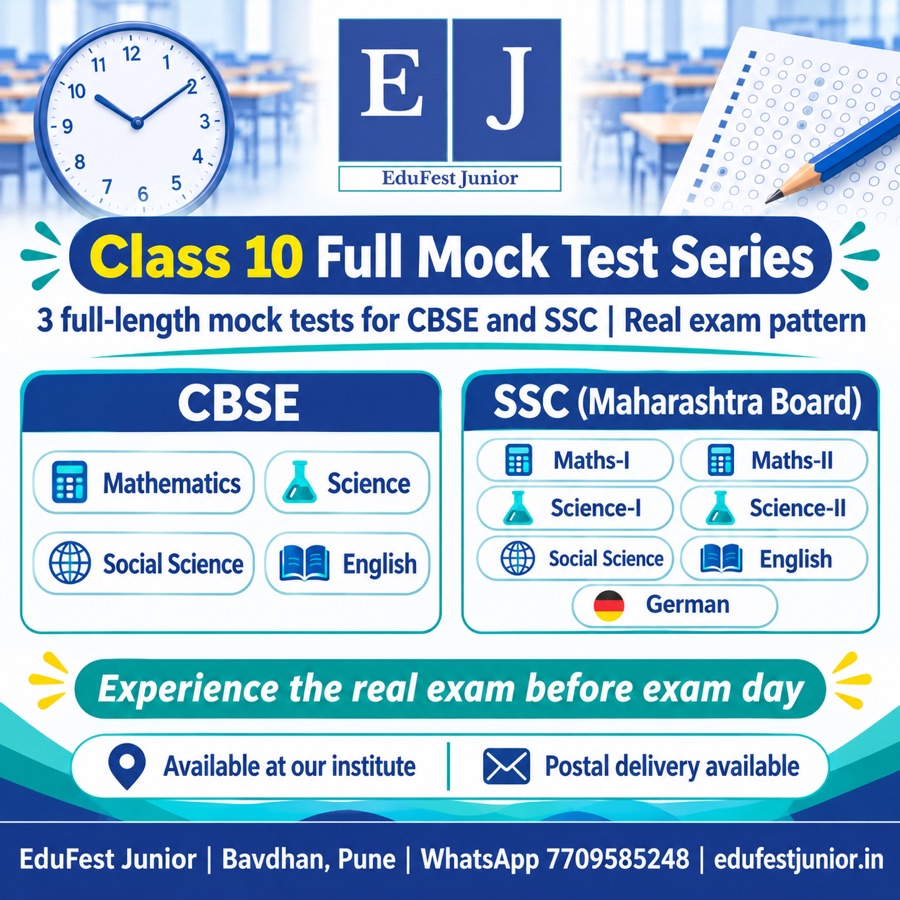
The Full Mock Test Series gives 3 full mock tests per board in real board paper pattern with an answer key, for Rs 4,000 per board. Take them at D-402 Dnyan Manjula, Bavdhan, or by postal delivery across India. WhatsApp 7709585248 or write to support@edufestacademy.in to enquire.
Frequently Asked Questions
Feel The Real Exam Before The Real Exam
Share your name and number and we will WhatsApp you the details of the Class 10 Topic-Wise and Full Mock Test Series.