Complete model answers to every question of the CBSE Class 10 English Communicative (101) Sample Question Paper 2026-27, covering reading, writing, grammar and literature, with the either-or options, matching the value points of the official marking scheme.
Feel The Real Exam Before The Real Exam
Want to practise full papers like this under exam conditions? Share your name and number and we will WhatsApp you the Class 10 Test Series details.
Quick Facts
| Paper | CBSE Class X English Communicative (101) Sample Question Paper 2026-27, with marking scheme |
|---|---|
| Marks and time | 80 marks, 3 hours, 12 questions, all compulsory |
| Sections | A Reading (22), B Writing (22), C Grammar (10), D Literature (26) |
| Pattern change | None for 2026-27, as printed by CBSE |
| Source | Official CBSE sample paper and marking scheme, cbseacademic.nic.in |
| Enquire about the test series | WhatsApp 7709585248 or support@edufestacademy.in |
How To Use These Solutions
This is the complete CBSE Class 10 English Communicative (101) Sample Question Paper 2026-27, answered by a teacher, in the order of the paper. The answers follow the official marking scheme.
English answers are value points, not fixed wording. The marking scheme says students can use their own expression if it is correct. Use our answers to check the ideas you should have covered, then write in your own words.
Read the passages and extracts in the official PDF (linked at the end) first, and try each question yourself.
Section A: Reading (Q1 and Q2, 22 marks)
Two passages: 12 marks and 10 marks. Base each answer on the passage. For 'explain' questions give a short answer in your own words, within the word limit.
-
Q1 (12 marks).
Passage on how travel changes a person (7 paragraphs). Q1.I. Why does the writer describe travel as more than 'a change of scenery'?
- Ait provides temporary enjoyment without lasting personal impact
- Bit provides a brief escape from everyday duties and routines
- Cit leads to transformation of one's outlook and self✓
- Dit increases awareness of one's regular habits and surroundings
Step 1: The passage says travel can 'shake off our usual certainties' and let 'a wider self' emerge. That is a change in outlook, not just scenery.
Answer: (C) it leads to transformation of one's outlook and self
-
Q1.II (1 mark).
In the line 'a wider self begins to emerge', the word 'wider' indicates ____
Answer: a broader and more inclusive sense of identity (the other two choices, a physically expanded self and an unclear identity, do not fit the context).
-
Q1.III (1 mark).
What does Pico Iyer mean by 'you can't define yourself as you used to'? It means that travel ____
- Aremoves all memories of a person's past life.
- Bcompels individuals to abandon their cultural origins.
- Cquestions fixed identities formed by habit and familiarity.✓
- Deliminates the need for personal identity altogether.
Step 1: In a foreign place the familiar routines and landmarks that anchored our identity fall away.
Answer: (C) questions fixed identities formed by habit and familiarity
-
Q1.IV (2 marks).
Give two reasons why encountering unfamiliar cultures can transform a traveller's worldview. (30-40 words)
Model answer: Encountering unfamiliar cultures exposes a traveller to different traditions, beliefs and lifestyles. These experiences challenge existing assumptions and encourage reflection, helping the traveller develop a broader, more open-minded understanding of the world.
-
Q1.V (1 mark).
The phrase 'the journey becomes a mirror' creates the imagery of a ____
- Areflection revealing one's inner self✓
- Bwindow opening to the outer world
- Cshield protecting personal beliefs
- Dmap guiding physical travel
Step 1: A mirror shows you yourself. The writer adds that the unfamiliar 'acts as a magnifying glass on the self'.
Answer: (A) reflection revealing one's inner self
-
Q1.VI (1 mark).
What would be the most suitable title for Paragraph 4?
- APleasure, Escape and Recreation in Travel
- BDiscomfort, Adjustment and Challenge in Travel
- CHumility, Empathy, and Growth Through Travel✓
- DDifference, Distance and Division in a Globalised Travel
Step 1: Paragraph 4 says 'Travel's greatest gift may be humility' and speaks of resilience and empathy.
Answer: (C) Humility, Empathy, and Growth Through Travel
-
Q1.VII (1 mark).
Paragraph 4 includes a _______ (observation / warning / reflection) about how travel challenges assumptions and builds empathy.
Answer: observation. The paragraph describes what travellers experience; it does not warn or look back on the writer's own journey.
-
Q1.VIII (1 mark).
Which phrase from Paragraph 5 shows that travel does not need to be international to be transformative?
Answer: 'Even within one's own country'
-
Q1.IX (2 marks).
Why does the writer describe travel as an experience that inspires growth? (30-40 words)
Model answer: Travel pushes individuals beyond their comfort zones. Facing unfamiliar situations builds adaptability, broadens thinking and deepens the understanding of oneself and others, which leads to emotional and intellectual growth.
-
Q1.X (1 mark).
Why does the author suggest that travel helps individuals develop empathy and resilience?
Model answer: Travel puts people in unfamiliar situations where they must adapt, negotiate differences and understand diverse ways of life. This gives them greater emotional strength and compassion.
-
Q2 (10 marks).
'Each One Teach One' project notice (reading). Q2.I. The initiative challenges the idea that learning is primarily a ____
- Astructured institutional obligation
- Bcompetitive individual pursuit✓
- Cgovernment-regulated system
- Dperformance-based evaluation model
Step 1: The notice says 'Learning is not a competition' and that students become 'partners in progress' instead of competing.
Answer: (B) competitive individual pursuit
-
Q2.II (1 mark).
When the passage states that 'teaching strengthens what they know', it implies that peer instruction leads to ____ understanding.
- Asuperficial and temporary
- Bmemorised and mechanical
- Creinforced and conceptually deeper✓
- Dexamination-oriented and strategic
Answer: (C) reinforced and conceptually deeper
-
Q2.III (1 mark).
True or False: The initiative suggests that academic excellence is best achieved through individual competition rather than collaborative responsibility.
Answer: False. The initiative says learning grows when it is shared.
-
Q2.IV (1 mark).
Select the option that best explains the phrase 'partners in progress'.
- Astudents working separately to achieve their own academic improvement
- Bclassmates supporting each other to achieve shared academic growth✓
- Clearners competing actively to secure higher academic positions
- Dteachers monitoring students to ensure steady academic progress
Answer: (B) classmates supporting each other to achieve shared academic growth
-
Q2.V (2 marks).
Explain how the initiative benefits the student-teacher beyond academic revision.
Model answer: The student-teacher develops patience, leadership and empathy. By teaching others, they also discover gaps in their own understanding and gain deeper self-awareness, which strengthens both character and confidence.
-
Q2.VI (1 mark).
The phrase 'no student feels left behind' suggests ____
- Aautomatic promotion of all students regardless of performance levels
- Bcomprehensive emotional and academic inclusion within the classroom✓
- Ccomplete abolition of examinations across all grade levels
- Dtotal elimination of differences in student ability and performance
Answer: (B) comprehensive emotional and academic inclusion within the classroom
-
Q2.VII (1 mark).
By encouraging students to support peers who hesitate to ask questions, the project transforms learning from a competition into a __________.
Answer: shared responsibility
-
Q2.VIII (2 marks).
How does the initiative challenge traditional ideas of academic success? Explain with reference to the text.
Model answer: It shifts the focus from marks and competition to cooperation and collective growth. Success is measured not only by personal achievement but by the ability to help others learn and grow, which creates a supportive learning community.
Section B: Writing (Q3 to Q6, 22 marks)
An application (3), a factual description (4), a letter to the Editor (7) and an article (8). Q5 and Q6 have an either-or choice.
-
Q3 (3 marks).
As Riya of Class X-B, Vidyabhavan Public School, write an application to the Principal asking permission to set up a Reading Corner. State how it will benefit students and suggest one way to manage it. (Format 1, content 1, accuracy 1)
Content points: state the purpose and seek permission; explain how it will improve reading habits, vocabulary and concentration; suggest one way to manage it (a student in-charge, a book register or a rotation system).
Model:
To, The Principal, Vidyabhavan Public School. Date.
Subject: Request for permission to set up a Reading Corner in Class X-B
Respected Madam, I request your permission to set up a Reading Corner in our classroom with books donated by students. A Reading Corner will improve our reading habit, enlarge our vocabulary and help us concentrate during free periods. To manage it well, a student in-charge can keep a register of the books issued and returned. I shall be grateful for your kind permission. Yours obediently, Riya, Class X-B
-
Q4 (4 marks).
Write a factual description of the school library in not more than 100 words: its layout, seating and the resources and facilities for students and teachers. (Content 2, organisation 1, accuracy 1)
Content points: physical layout (space, seating, workstations); variety of genres; resources and facilities.
Model:
Our school library is a spacious, well-lit hall on the first floor. Rows of steel shelves line the walls, and long wooden tables with chairs sit in the middle, with a quiet corner for individual study. There are four computer workstations with internet access. The library holds about ten thousand books across fiction, science, history, biographies and reference, along with newspapers, magazines and encyclopaedias. Students can borrow two books at a time for two weeks. Teachers have a separate shelf of reference books and journals. A librarian helps with searches and a photocopier is available.
-
Q5 (7 marks).
Either A or B, in 120-150 words. Format 1, content 3, organisation 2, accuracy 1. A. As Anish Khanna of 45, Green Park, New Delhi, write a letter to the Editor on the misuse of antibiotics for minor illnesses (use MCB Unit 1: Health and Medicine). OR B. As Meera Singh of 102, Rosewood Colony, Jaipur, write a letter to the Editor on how schools contribute to value education.
Format: sender's address and date, the Editor's address, the subject line, 'Sir/Madam', the body in short paragraphs, 'Yours faithfully' and your name.
Option A, the marking scheme's content points: concern about the growing misuse of medication for minor illnesses; the causes (self-medication and lack of medical advice); harmful effects such as antibiotic resistance and weakened immunity; long-term risks to health; the need for awareness and responsible use; an appeal to authorities, doctors and the public.
Option B, the content points: the rise of coaching centres, online tutors and AI platforms; the unique role of schools in value education; how schools teach discipline, empathy and social responsibility; the importance of human interaction and peer learning; teachers as role models; holistic development beyond academics.
How to write it: use one paragraph for the issue, one for causes and effects (or the school's role), and one for the appeal. Keep to 120-150 words.
-
Q6 (8 marks).
Either A or B, in 150 words. Format 1, content 3, organisation 3, accuracy 1. A. As Soham Sharma, write an article for the school magazine on 'Promoting Social Harmony in a Diverse Society' (MCB Unit 6: National Integration). OR B. As Kritika Kapoor, write an article on 'The Role of Renewable Energy in Building a Sustainable Future' (MCB Unit 3: Science).
Format: a title, the writer's name (by-line), then the article in an introduction, a body and a conclusion.
Option A, the marking scheme's content points: define social harmony in a diverse society; key values (respect, tolerance, cooperation); its importance for national integration; unity in diversity as a national strength; small acts that promote harmony; the role of students in daily life; practical steps for peaceful coexistence; the benefits of social harmony as the conclusion.
Option B, the content points: define renewable energy; major sources (solar, wind, hydro, biomass); benefits to the environment and society; less pollution and less dependence on fossil fuels; recent innovations; challenges (cost, infrastructure, awareness); actionable steps to promote clean energy; a conclusion on the need for a sustainable future.
How to write it: follow the cues printed in the question in order, and give each cue a short paragraph.
Section C: Grammar (Q7 to Q9, 10 marks)
Gap filling, editing, rearranging and reported speech.
-
Q7 (3 marks).
Fill in the blanks with the right option: Urban green spaces play an important role in improving mental health and are central to cities' plans of (i) ___ (promote / promoting / promoted) sustainable living. For many people, nature-based solutions (ii) ___ (was seen / are seen / seeing) as optional luxuries, but modern research proves their necessity. Today, governments (iii) ___ (recognise / recognised / recognising) green spaces as an essential part of urban development.
(i) promoting. After the preposition 'of' we use the -ing form.
(ii) are seen. 'Solutions' is plural, so we need the plural passive.
(iii) recognise. 'Today' and 'governments' call for the present simple, plural.
-
Q8 (4 marks).
Editing: one word is missing in each line. Write the missing word with the word before and after it.
(i) 'you find local restaurants serving': you / will / find.
(ii) 'a platter offering choicest dishes specific': offering / the / choicest. 'The' goes before 'choicest'.
(iii) 'to that region. However it is more than': is / much / more. 'Much more than' is the correct phrase.
(iv) 'just a part the country's dining-out culture.': part / of / the.
Tip: read each line aloud. The missing word is usually an article, a preposition or an auxiliary verb.
-
Q9 (3 marks).
I. Rearrange the jumbled words to complete Rohan's reply: (i) I agree/ share ideas easily/ people connect and/that/but at the/ causes stress / same time it. II. Report the conversation between Anika and Kabir by filling in the blanks.
I (1): Rohan: I agree that people connect and share ideas easily but at the same time it causes stress.
II (2): (i) if he had seen the art exhibition at the city museum the previous day. (ii) that the paintings and sculptures had been amazing.
Rule: a yes-no question is reported with 'if' or 'whether', the past simple becomes the past perfect, and 'yesterday' becomes 'the previous day'.
Section D: Literature, the Extracts (Q10, 8 marks)
Answer any two of the three extracts. Each has four 1-mark questions.
-
Q10 (8 marks).
Answer any two of the three extracts, four 1-mark questions each. A. A Shady Plot (the speaker's past). B. Not Marble, nor the Gilded Monuments (Shakespeare's sonnet). C. Julius Caesar (Antony over Caesar's body).
Extract A (A Shady Plot):
I: The speaker expresses strong regret and bitterness towards her past, suggesting that the suffering was so intense that even painful situations later seemed better by comparison.
II: She gave it up because her earlier work caused emotional exhaustion and dissatisfaction. She was drained, disillusioned and looking for stability.
III: Sighing and rubbing her nose suggest nostalgia mixed with pain: recalling the past stirs lingering discomfort and weary reflection.
IV: The resolve shows a shift from passive endurance to active self-determination. She wants to redefine herself and take control of her present identity and future.
Extract B (the sonnet):
I: 'Wasteful war' shows that human conflicts are destructive and indiscriminate, and erase physical achievements and cultural creations over time.
II: 'The living record of your memory' suggests that poetry keeps memory more permanently than physical monuments, so it is timeless and free from decay.
III: The references to Mars's sword and war's quick fire stress the power of war to destroy material things, and contrast it with poetry's ability to give immortality.
IV: Human achievements like poetry outlast time and destruction, while wars and monuments eventually fade into oblivion.
Extract C (Julius Caesar):
I: Antony means that Caesar, though physically destroyed, was once the greatest and most honourable man, and is now a tragic remnant of his former glory.
II: The line gives Caesar's wounds a human voice, which deepens grief and pity and strengthens Antony's emotional appeal to the crowd.
III: It shows that Antony knows Caesar's murder will lead to chaos, revenge and widespread civil war in Rome.
IV: The image shows a complete moral collapse, where violence has become so normal that even a mother's instinct is destroyed by war.
Section D: Literature, the Short Answers (Q11, 10 marks)
Any five of six, in 30 to 40 words each.
-
Q11 (10 marks).
Answer any five of six questions in 30-40 words each (2 marks each).
I. Ozymandias: The 'cold' heart stands for the king's arrogance and lack of compassion. It reflects his cruel pride and emotional emptiness, and suggests that his power rested on tyranny and not on humanity.
II. A Shady Plot: Humour arises from the ghost Helen's casual behaviour and the narrator's confusion. This light treatment of the supernatural reduces fear and shows the clash between logic and imagination in a playful way.
III. Mrs Packletide's Tiger: The villagers give up their morals for money. They know the tiger is old and harmless, yet they help arrange an easy hunt by tying it up and staying silent. For financial gain they join the deception, which shows how money can overpower moral values.
IV. Two Gentlemen of Verona: Nicola and Jacopo are young boys but carry adult responsibilities to pay for their sister's treatment. The contrast shows their maturity and selflessness, and the depth of their sacrifice at such a tender age.
V. The Rime of the Ancient Mariner: The vast, icy Antarctic landscape and the endless sea create desolation. The crew is trapped in a hostile place, which stresses their physical isolation and spiritual helplessness.
VI. The Frog and the Nightingale: The Frog uses his status and experience in the bog to dominate the Nightingale. He exploits her insecurity and talent to control her, assert his authority and keep his power.
Section D: Literature, the Long Answer (Q12, 8 marks)
Either A or B, in about 150 words.
-
Q12 (8 marks).
Either A or B, in about 150 words. A. Compare the boys' silent sacrifice in Two Gentlemen of Verona with Coachman Ali's patience in The Letter. What do the stories suggest about selfless devotion? OR B. Compare how the characters in The Dear Departed and Mrs Packletide's Tiger show greed, jealousy and self-interest. Evaluate the message.
Content points from the marking scheme.
Option A: the silent sacrifice of Nicola and Jacopo for their sister; Coachman Ali's patience and unconditional love for his daughter; love shown through endurance, not words; selfless devotion without expectation of reward; the message that true love is sincere, loyal and enduring.
Option B: the greed and self-interest of Mrs Slater and Mrs Jordan; Mrs Packletide driven by jealousy and the desire for social prestige; hypocrisy and moral weakness exposed; human values ignored for personal gain; the message that selfishness leads to moral downfall.
How to write it: open with the idea that both stories share, give one paragraph to each story with a specific detail, and close with the message in one or two sentences. Keep to about 150 words.
Five Answer-Writing Habits That Earn Marks In English
- 1. Answer from the passage. In reading questions, base every answer on the text, and keep to the word limit of 30 to 40 words.
- 2. Use the right format. Marks are given for the layout of an application, a letter and an article. Learn each layout.
- 3. Follow the cues. In Q5 and Q6, cover every cue in the question, in order, with your own ideas.
- 4. Show the three words in editing. Write the word before, the missing word and the word after, as in the example.
- 5. Check accuracy at the end. Spelling, punctuation and tenses are marked in every written answer. Leave two minutes to check.
More On The 2026-27 English Communicative Paper
Where This Paper Comes From
Everything here is based on the Sample Question Paper and Marking Scheme for Class X (2026-27), English Communicative (101), published by the Central Board of Secondary Education on cbseacademic.nic.in. Marks and the paper design are as printed by CBSE.
The tagging of each question to a chapter or skill is our own reading as teachers. Some questions use ideas from more than one chapter, so another teacher may tag one or two questions differently.
Ready To Try A Full Paper Under Exam Conditions?
Reading a solution is not the same as writing the paper in the exam hall. Use chapter-wise tests to find your weak chapter, then full mock tests in the real board pattern.
Two Class 10 Test Series At EduFest, Bavdhan, Pune
EduFest Junior Academy runs two separate series for Board Exam 2027, both starting 1 Dec 2026, for CBSE and Maharashtra State Board (SSC) students.
The Topic-Wise Test Series gives 10 chapter-wise Mathematics tests per board (Science is coming soon), with concept clarity first, real board-pattern papers, a separate answer key and chapter-wise weak-area diagnosis. Price is available on WhatsApp.
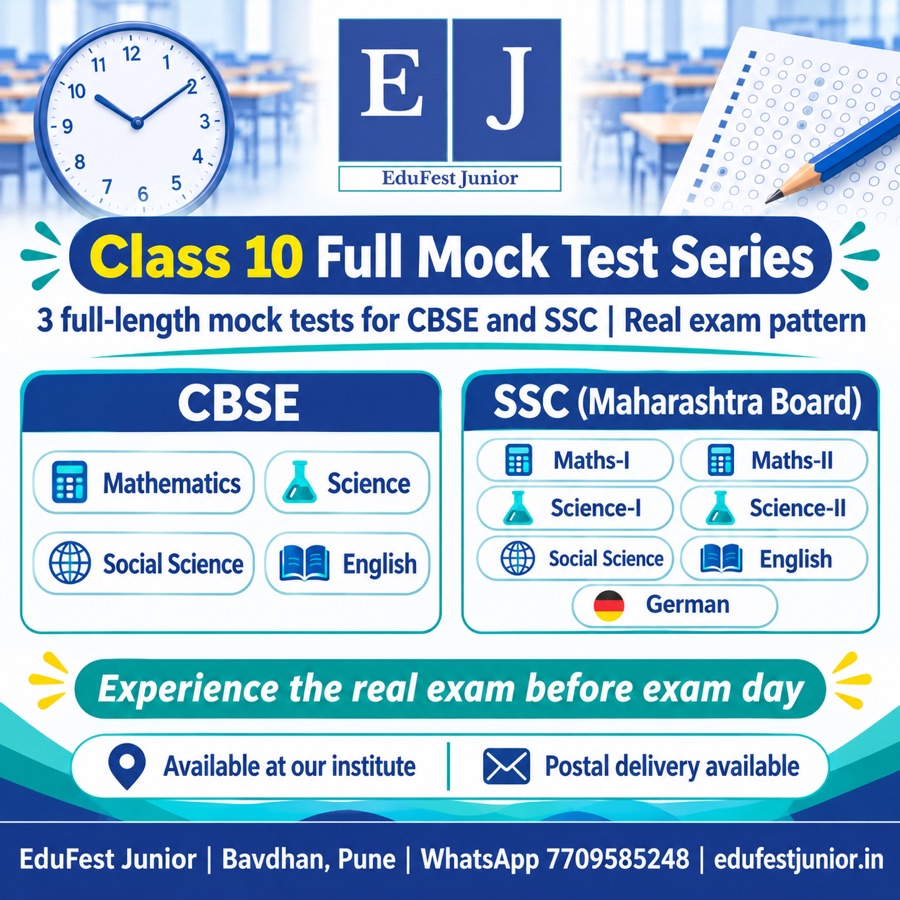
The Full Mock Test Series gives 3 full mock tests per board in real board paper pattern with an answer key, for Rs 4,000 per board. Take them at D-402 Dnyan Manjula, Bavdhan, or by postal delivery across India. WhatsApp 7709585248 or write to support@edufestacademy.in to enquire.
Frequently Asked Questions
Feel The Real Exam Before The Real Exam
Want to practise full papers like this under exam conditions? Share your name and number and we will WhatsApp you the Class 10 Test Series details.